Demystify Me: The ISO 9001 Standard
If you’ve ever Googled ISO 9001, you’ve probably seen a wall of jargon and thought… “nope”. Let’s cut through the noise and explain it in plain English.
What is ISO 9001?
ISO 9001 is a set of rules for how you run your business, so things are correct and consistent. It’s all about quality.
Not just the quality of what you sell or the services you deliver, but the way you work every day.
I like to explain it as: “knowing what we need to do and doing what we say we will do”.
Think of it as a recipe for a well-run organisation. If you follow the recipe, your outcomes are more consistent, your customers are happier, and your team knows what’s expected.
Let’s clear up a key term you’ll hear a lot - ‘QMS’. It stands for Quality Management System. It’s really just a fancy way of saying everything we do to make sure quality happens.
It includes your policies, processes, tools, systems, records, and the way your people work together.
How it’s structured
The standard has 10 sections (called clauses), but only 7 are things you have to do (the first 3 are background).
In plain language, here’s what those “must-do” sections cover:
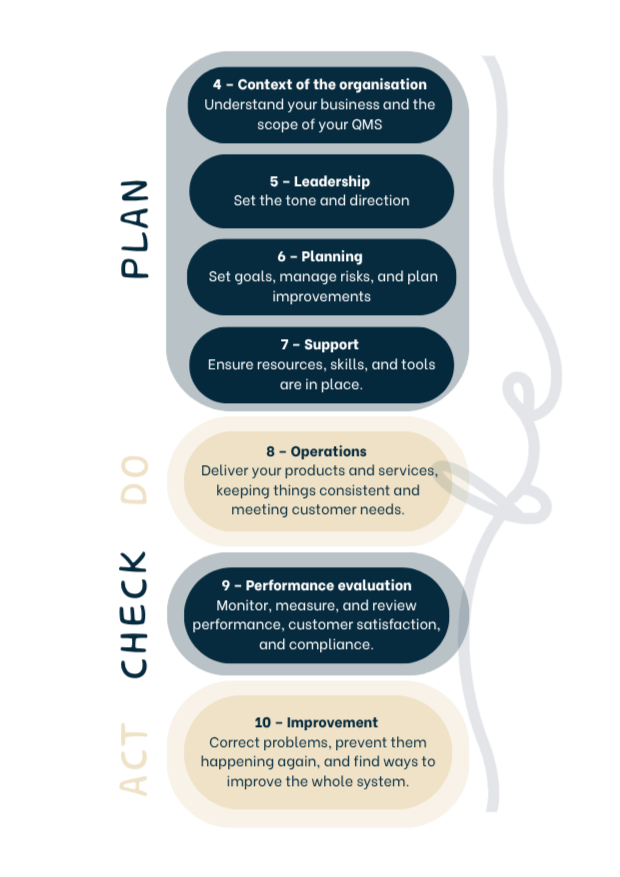
(4) Context of the organisation: Understand who you are, what you do, who you serve, and decide the scope of your Quality Management System (what’s in and what’s out).
(5) Leadership: Leaders set the direction, lead by example, and create a culture where quality is valued.
(6) Planning: Look ahead at risks and opportunities, set quality goals, and plan how you’ll achieve them.
(7) Support: Make sure your people have the right skills, resources, tools, and environment to do their jobs well.
(8) Operations: The “doing part” of your products and services.
(9) Performance: Measure what’s working (and what’s not).
(10) Improvement: Keep learning from mistakes, acting on feedback, and making your systems and processes better over time.
How to make it work without overcomplicating it
Build on what’s already in place: You might already have parts of ISO 9001 covered without realising it, like a Board-approved mission and vision, a strategic plan, documented policies, records of employee training requirements, or regular team meetings;
Involve your team: They know the work best and can spot gaps or improvements quickly;
See ISO 9001 as a framework, not a cage: It’s meant to guide you, not box you in with unnecessary paperwork;
Keep it ‘real-world’: Build your QMS around how your organisation actually works;
Use what works for you: If your current tools, templates, and processes do the job, keep them. Many organisations buy off-the-shelf documents and then try to adapt their work to match. Often, what you already do will meet the requirements. ISO 9001 should fit around your organisation, it’s not one-size-fits-all;
Make it part of everyday work: Quality shouldn’t be something “extra” people quickly do just before an audit. It should be the way you work all the time. If you can make it business as usual, you will improve the sustainability of your organisation!
Aligning ISO 9001 to the PDCA Cycle
Plan – Do – Check – Act : This is the engine behind a good QMS. It’s how you move from “we have processes” to “we actually improve how we work”.
In plain English, it looks like this:
Plan – Work out what you’re trying to achieve, what could go wrong, and how you’ll do it;
Do – Put your plans into action and deliver your services;
Check – Review how things went, measure results, and identify what’s working (and what’s not); and
Act – Make improvements, fix issues, and adjust your approach for next time.
The image below outlines how PDCA aligns to the clauses within ISO 9001: